Featured

Digital WebCogitate

In a world where inequality is the norm, attaining success is as difficult as it gets, especially for small businessmen working independently at the grassroots. Tribe3 was formed, with an aim to uplift the 3 billion who are economically under-served but have great potential, by identifying capable entrepreneurs and providing them with capital.

visit us – https://www.tribe3.com/

tribe3

Contact us :

Address : 203, Orchids B, Lane No 10, Ubale nagar, Wagholi, Pune

contact number : 917666207768

Website : http://www.webcogitate.com/

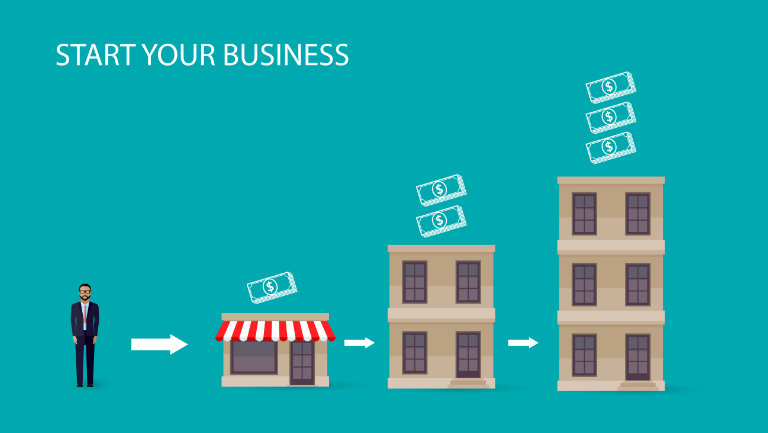
Starting your own business has never been a cake walk. But receiving business loan for new business (finally!) makes it all worth the efforts. Toss the confetti. You’ve reached the START line. Now you’ve the power and the tools to take further steps and embark on a journey of running a successful business.

What comes next is a mix of business fundamentals that can spring you up to the winning podium. Say hi to these five.

Pen your plans

Ideally, you should have your plan ready much before you seek business loan funding. If not, it is never too late to chalk it out – because without a plan, it is merely a dream. You just need an outline of business objectives, strategies, sales plan, marketing approaches and more. At the same time, it is also important to not be married to a plan. Businesses often witness that a best-laid plan can be thrown in a trash bin, even after receiving adequate start-up loan for new business. The key is to gauge how long to stay with the plan and be ready with plan B.

Value your people

Train, trust and treat – are the three golden words to follow when you manage your people.

Train them well to do their jobs

Even if you’ve recruited experienced professionals, who have been in a similar role, in their previous stints – training is the first step. Knowing how you want them to handle their jobs makes them feel more competent, increasingly empowered and proud of their contribution.

Trust your team.

Don’t be a control freak. Delegate tasks effectively and you will get more and better then you expect. Parallelly, set up a structure to allow your employees to contact you without interfering in your own schedule.

Treat them to a reward.

Ignore National Employee Appreciation Day because employee recognition knows no calendar. Make it an important part of your culture all year long to applaud your employees when they are least expecting it.

Market it right

It would have been nice if an ‘Open’ sign on the front door or a website that has finally gone live could fetch you customers. But life is not that easy. Marketing yourself needs a smart tactic to get spotted in the big, bad crowd. It is important to make potential customers aware of something they may not possess and engage them enough so that they listen to your pitch. Remember, without an impactful, efficient and memorable marketing effort, nobody is going to reach out to you out of the blue.

Impress and engage your customers.

Imagine how you would like to be treated and treat your customers a tad better. Your customers are people and not a mere number or a means to an end. They have a personality, preference and the power to be with you or not. So if you add value to their association with you, you can be sure that you’ve built a strong and lasting customer relationship.

De-clutter your business

When you’re fairly settled in your business, relook at every element that shapes it. Be it an employee that is not adding value, a customer who’s draining your resources, or equipment, documents, furniture that no one uses anymore – remove anything that does not make your workspace happier, healthier or more productive. Don’t forget to count-in the mental clutter within your office space and inside your head.
So, when you attain new heights in your business, come back to these vital points. Mentally put the puzzle together to see how all these small pieces add up to your larger goals. And if you need to fund your bigger dreams, reach out to Tribe 3 for easy business loans in India.

Internet of Things

The world is talking about Internet of Things (IOT), workplace or outside everyone is intrigued with this new phenomenon. So what is Internet of Things exactly and why are people so intrigued?

IOT can be defined as a network of devices like cars, home appliances and other items embedded with electronics, software, sensors, actuators and connectivity which enables these objects to connect with each other and exchange data. Each object is unique and interconnected within the same internet infrastructure with other devices.

In simple terms, IOT is the concept of connecting multiple devices under a common internet infrastructure so they can be controlled remotely with little to none manual intervention. From everyday objects like your TV, air conditioner, light bulbs, cell phones to hi-tech machinery in factories almost all can be embedded with software and sensors and controlled automatically using IOT.

Gartner, an analyst firm predicts that by 2020 there will over 26 billion devices that could be integrated using IOT. This very clearly suggests that most of our daily objects at work and home will be integrated with IOT making our lives very comforting. IOT devices have the capability of sharing data with each other, thus creating a lot of data about the choices, likes and dislikes of an individual. This  can help simplify our lives as a lot of our everyday decisions or choices will be made by these devices automatically. For example; your car may send notifications on your cellphone when it requires servicing or something needs repairing, or on a hot day you can set the air conditioner to cool of your home while you are leaving from your work place.

These are simple examples of what large feats are possible once IOT comes in full force. IOT will bring about a lot of changes not just at home but in the overall environment as a whole. Homes, factories, farms, manufacturing units, service providers all that can be connected will be. And this will have a very strong impact on our lives. Automation, reductions in wastage, energy savings and many other such benefits will result in efficient, clean and smart cities and reduce costs and losses on a huge scale.

With so many positives IOT is not only intriguing but also much awaited. However, another aspect that has a serious impact on us with IOT coming in is personal privacy and security. Do we really want so many connected devices sharing our personal information freely to our service providers? How much privacy are we willing to compromise for IOT? With nations always worried about national safety and terrorism do we actually want so many devices collecting our everyday life information and making it openly available? And what about hacking – with IOT being so huge and everything connected a simple breach may result in huge losses. SECURITY is the biggest concern when it comes to IOT and protocols need to be established and followed very strictly if we are to fully enjoy this life changing concept of  IOT.

Discussions on IOT have been going on throughout the globe for many years and the positives and challenges of more and more devices joining under IOT needs to be thought upon. For now all we can do is try to understand more and more about IOT and how it will impact our lives in the near future.

visit us : http://www.webcogitate.com/?utm_source=wordpress

WebCogitate|Artificial Intelligence

Coined by John Mcarthy in 1956 the concept of how Artificial Intelligence (AI) is defined has changed over time. With that said the AI at its core has always been about creating a computer, a machine, a robot or a software program that can think intelligently, just like a human.

AI as a concept is a much broader than merely a smart computer or a robot as it is generally thought to be. Rather AI is about creating a machine/ computer or software which can mimic and function just like an intelligent human brain functions. It also makes sense to base AI on the human brain as we humans are the most capable to observe, understand and act in accordance to our environment.

And that is where the challenge lies, creating an intelligence artificially that can from the information provided or collected, learn, observe, understand and provide solutions and take actions and at the same time it should be intelligent, rational and ethical.

In other words, AI is a branch of computer science whose main purpose is to create machines and software as intelligent as humans.

Aspirations

Broadly AI has two major purposes:

  1. Create expert systems: Systems which exhibit intelligent behavior, learn, demonstrate, explain, advice and provide solutions to its users.
  2. Implement human intelligence in machines: Create systems that understand, think, learn and behave like humans.

To further understand or break down the concept of AI we need to understand that AI as a technology or a science is not an independent one but depends heavily on other branches of science such as computer science, engineering, psychology, mathematics, linguistics and biology.

The ability of a system to calculate, reason, perceive relationship and analogies, learn from experience, store and retrieve information from memory, solve problems, comprehend complex ideas, use natural language fluently, classify, generalize, and adapt new situations. All these abilities together create what we call intelligence. Also, there can be  multiple type of intelligence, linguistic, mathematical-logical, musical, interpersonal, spatial, bodily-kinesthetic to name a few. You can say a system has artificial intelligence when it is equipped with at least one at the most all of these intelligence.

When we consider the above reasoning we realize that AI is no longer a thing of future, it is in the here and the now. Consider automated cars, virtual reality gaming, factory process flows that require no human interventions. Consider “Siri” or “Alexa” personal assistants who understand human speech and understand what we want or need. Look at services like Apple store or Youtube which suggest us various new music and videos based on what we have previously watched or showed interest in.

In closing, there are only small and simple examples of what AI is capable of. As AI grows exponentially it is imperative to consider its long term impact on the environment and human race.

visit us : http://www.webcogitate.com/?utm_source=wordpress

6 Easy ways to keep your Credit Score Eligible for Business Loans

As a small business owner in India, you probably know that keeping a sound credit score is integral for securing a business loan. This is because it tells the lender how trustworthy you are. A high credit score indicates that you pose minimal risk to the lender. So, getting a business loan approval would be a breeze, provided you meet the other standard requirements of the lender – such as annual revenue and overall business experience.

A low credit score, on the other hand, will make it very difficult to get an unsecured business loan, even if you meet or exceed the other requirements.

Exactly, what is a good credit score?

The credit score scale ranges from 300-900. Anything above 750 puts you in good stead to secure a small business loan in India.

How can you check your credit score?

In India, there are six primary credit bureaus to perform credit assessments. They are CRISIL, CIBIL, ICRA, Equifax, CRIF High Mark, and Experian. You can log into any of their websites and check your credit score, before you apply for a small business financing loan.

What can you do if your credit score is low?

A good credit score is the first thing a lender looks for in your business loan application. It is a measure of your ability to clear your debts on time, based on your past transactions. A poor credit score or the lack of one severely dents your chances of seeing the stamp of approval on your business loan application form.

But it is not the end of the road. Even if your present credit score does not cross the threshold mark, there are ways you can rely on to improve and maintain it.

Let us look at 6 of the most important ways:

1.    Keep Regular Tabs on Your Credit Score

Many people make the cardinal mistake of checking their credit score right before they are in need of easy small business loans. This might not give them enough time to deal with a negative remark on their credit score report. On the other hand, checking your credit score periodically – once every 4 or 6 months – will give you ample time to take the necessary steps to counter situations like these, much before applying for a finance for business.

Also, there is a misconception that checking your credit score affects your rating. The reality is when you check your credit score, it is considered a ‘soft inquiry’. Unlike a ‘hard inquiry’, a soft inquiry does not affect your credit score and is not visible to lenders.

2.    Pay ALL Your Debits Timely (even the ones you consider small or insignificant)

Your unpaid debts – credit card bills, EMIs – can be a major roadblock to your application for finance for a business. Any payment defaults will drag your credit score down. Be it a cash crunch scenario or a case of missing the due date, you will eventually lose out on getting a small business loan.

So to avoid such scenarios, ensure that you set reminders for all your monthly payments. You can turn to technology such as mobile phone applications to assist you in this regard. As far as cash crunch scenarios are concerned, effective budgeting beforehand can help you stay out of it.

3.    Avoid Simultaneous Loan Applications

Applying for small business financing loansto multiple lenders in a short time span reflects poorly on your credit score. In such cases, your credit score report will throw up multiple “hard inquiries” – inquiries made by lenders, which will adversely affect your credit score. To a prospective lender, you will come across as a credit hungry person.

Multiple business loan applications can also indicate that your debt burden may increase in the future – a red flag for lenders.

4. Be Wary of Joint Loan Applications

To increase the chances of a business loan application being approved, many turn to joint loan applications for business capital loans. Although this method does improve your chances, what you may miss is a possibility that your co-applicant makes a mistake leading to a default in payment. This will affect your chances of getting small business loans online.

5.    Keep an Eye on Your Credit Card Utilisation

For all your credit cards, you have to adhere to one simple rule – do not allow your card utilization to breach 30% of the total credit card limit. This will keep your credit scores stable. A high credit utilization limit can also indicate the possibility of a looming debt burden. If your credit utilization is high, take steps to lower it. Be financially disciplined and avoid using your credit card for all your purchases. Excessive usage allows the lender to look at your spending habits, something best kept to yourself.

A tip – Ask your credit card company to alert you if you are closing in on the utilization limit.

6.    Take A Loan

At first glance, this may seem counterproductive. But, it is actually a very effective way to boost your credit score. This is especially handy if you don’t have a credit score at all. Remember –having no credit history doesn’t qualify you as a good candidate to receive a quick business loan. This is because the lender will have no idea if you can repay on time.

So, take an easy business loan; an unsecured business loan is a better option if you don’t want to risk mortgage. Pay your instalments on time, and if you can, try to close the business loan early. This will help you build your credit score.

5 Ways to Get Small Business Funding in Mumbai

The availability of finance for business is a recurrent factor in starting or sustaining any business. Apparently, however, according to a recent survey, statistics show that over 94% of the small businesses take a back seat due to ignorance in exploring various opportunities when it comes to finance for business.

That’s often the case, at almost every stage, entrepreneurs end up asking the question—How do I finance for business?

Moreover, Mumbai is famously known as the financial capital of India. Accordingly, the problem of weak bank balances in a big city like Mumbai is a grave for small and medium enterprises.

In a metropolitan city, the competition is huge due to the rapid multiplication of commercial ventures. Survival of the fittest is a norm, where access to quick and easy small business loans will determine the success for SMEs.

Here are some options to get easy small business loans for your business.

1.Bootstrapping your business:

Bootstrapping, otherwise known as self-funding is the most viable way to start your small business. As opposed to the various easy small business loan options available, this is the more effective for the first-time entrepreneurs.

Bootstrapping is also about stretching resources – both financial and otherwise – as far as they can. You might want to start early, implementing your money-saving plans to reap out the benefits.

2. Financial Help from Microfinance Providers or NBFCs:

There’s another way if need a loan for new business. Basically, this is a lucrative option, if you don’t qualify for a bank loan.

So, if you need a loan for new business, and you’re limited and credit ratings not favored by the bank, this is it for you.

3. Government Programs for startups:

There’s no shortfall in small business financing loan opportunities from the government.

The government of India, as a wing to cater the small business financing loan opportunities in India,  has launched 10,000 Crore Startup Fund in Union budget 2014-15 to improve  the startup ecosystem in India.

4. Bank Loans:

The first choice, when it comes to availing a small business loan in India is getting the fund from a bank.

For an in-depth study, small business loan in India through banks comprises providing the working capital loan, and the other is funding.

Working Capital loan is the loan required to run one complete cycle of revenue-generating operations, and the limit is usually decided by hypothecating stocks and debtors.

For availing a small business loan in India from a bank, the procedure is somewhat detailed and tedious— sharing the business plan and the valuation details, along with the project report, based on which the loan is sanctioned.

5. Unsecured business loans:

 There is this one easiest funding options you can look for —run your business with unsecured business loans.

Many digital lending companies offer unsecured business loans – which are loans given to  SMEs without any security of collateral.

These collateral-free loans for SMEs are offered with flexible repayment options, disbursed within a short period of time, to cover short-term needs. The sweet spot is you can apply from anywhere.

Digital lenders offer such loan, provided you meet certain criteria and are able to provide some documents for verification purpose to receive an unsecured business loan.

While the plethora of small business loan options may make it easier than ever to get started, responsible business owners should ask themselves how much margin do they need for the business loan for funding their small business.

It’s better to start from the beginning with good corporate governance for a small business loan,as it might get hard to go back later and try to exert fiscal discipline.

WebCogitate : Micro-services

Micro-service architecture, a word that has grabbed everyone’s attention and is gaining momentum everyday. So, what is micro-service, why does everyone want to shift to it and why do we need it? Let’s understand the concept of micro-service architecture in detail.

The central idea behind micro-services is that some types of applications become easier to build and maintain when they are broken down into smaller, create able pieces which work together. Each component is continuously developed and separately maintained, and the application is then simply the sum of its constituent components. This is in contrast to a traditional, “monolithic” application which is developed all in one piece.

Monolithic Architecture

In a monolithic architecture, we will need just one code base. That code base will have all code related to all modules. For small projects monolithic architecture is preferred. The actual issue arises when the number of modules increases significantly.

Issues that could arise because of monolithic architecture are:

  • It will be difficult to manage the code base
  • Monolithic applications can also be difficult to scale when different modules have conflicting resource requirements
  • Monolithic applications has a barrier to adopt new technologies. Since, changes in framework or languages will effect an entire application, it is extremely expensive in terms of time and cost
  • Another problem with monolithic applications is reliability. Bug in any module (e.g. memory leak) can potentially bring down the entire process. Moreover, since all instances of the application are identical, that bug will impact the availability of the entire application
  • You must redeploy the entire application on each update
  • Impact of a change is usually not very well understood which leads to do extensive manual testing

Micro-service Architecture

Micro-service architecture says that we divide our application in small independent services which works independently and ideally do not communicate with each other. This could be said that A service has no knowledge about B service.

Basically, the idea is to split your application into a set of smaller, interconnected services instead of building a single monolithic application. Each micro-service is a small application that has its own hexagonal architecture consisting of business logic along with various adapters. Some micro-services would expose a REST, RPC or message-based API and most services consume APIs provided by other services.

Also, not only code base, complete micro-service architecture says each service will have its own database and that database access is limited to particular service only.

Benefits of Micro-services

  • It tackles the problem of complexity by decomposing application into a set of manageable services which are much faster to develop, and much easier to understand and maintain
  • It enables each service to be developed independently by a team that is focused on that service
  • It reduces barrier of adopting new technologies since the developers are free to choose whatever technologies make sense for their service and not bounded to the choices made at the start of the project
  • Micro-service architecture enables each micro-service to be deployed independently. As a result, it makes continuous deployment possible for complex applications
  • Micro-service architecture enables each service to be scaled independently

Drawbacks of Micro-services

  • Using micro-service architecture means using distributed system. So, now there will be calls to various services at some facade layer (aggregation layer), where we need to handle RPC and service calls failure
  • Testing the architecture becomes difficult
  • Major issue comes when debugging the issue. To debug the issues, we need something to link calls between different services (done via distributed tracing)
  • In micro-services, our database are also partitioned.If a business requires transactions between various services then we need to take care of distributed transactions (SAGA Pattern)
  • You need to monitor and manage multiple applications

visit us : http://www.webcogitate.com/?utm_source=wordpress

What is SEO – For Beginners

Moved your business online? Have your website ready? Confused how to make it to the list of ‘top searched websites’? Well, one of the solutions to become one of the top searched websites is ‘SEO’ also known as ‘Search Engine Optimization’.

Search Engine Optimization is on-page optimization wherein the website is created with a clear hierarchy and text links to make it easy for the search engines to ‘crawl’ through the site. Search engines are ‘crawlers’ or ‘automated robots’ which go through (crawl) the website and store the relevant information. This process of storing relevant information is called ‘indexing’ and these information are recalled when needed for a search query. When an online search is performed, these search engines go through their database and show the results which match the search queries. Also, it ranks those results as per the popularity of the websites showing relevant results. Hence, ‘relevance and popularity’ are the two things which are influenced by the process of SEO.

To show the ‘relevant’ results to the search query, match your keywords to those queries. Create keyword rich content and URLs. Make a website which is rich in valuable information and its pages clearly describe the content (it is not buried inside JavaScript, Adobe Flash Player).

Search engines assume that more popular a site more useful the information it would contain. To rank these sites in order of their popularity mathematical algorithm is employed by these search engines.

*Following are some of the characteristics of web-pages that tend to rank higher:

  1. Domain-Level Link Features: Based on link/ citation metrics such as quantity of links, trust, domain-level Page Rank, etc.
  2. Page-Level Link Features: Page Rank, trust metrics, quantity of linking root domains ,links, anchor text distribution, etc.
  3. Engagement and Traffic/Query Data: Data SERP engagement metrics, click stream data, visitor traffic / usage signals, etc.
  4. Domain-Level Keyword Usage: Exact-match keyword domains, partial keyword matches, etc.

Search Engine Optimization makes websites understandable for search engines as well as users. It helps the engine find out what each page is about, and its usefulness to the users.

E-Learning – The way ahead

With the advent of technology E-learning has quickly become an integral part of the training industry. Business, education institutions and professionals are now migrating towards e-learning from the traditional classroom training. Apart from the obvious benefits of being flexible and not having to spend excess time and expenses on travel E-Learning also has many other benefits over the traditional training methods. Below mentioned are some of the advantages of E-learning:

Less expensive to produce, with  soft wares and applications like Trainers often you can create your own training courses without incurring much cost

It’s self –paced, most e-learning programs can be studied as and when the learner is free. The training courses can be created in small modules so the learner can focus, learn and move ahead as per his convenience

It moves faster, with e-learning the learner himself  is in charge of the training ,this helps him move the training at a faster pace as he can skip parts of the course which he already knows and focus on the parts he actually needs training

It’s consistent, e-learning eliminates the problem of different trainers speaking different content on same subject. This is especially important and quite crucial in company based training

Easily accessible, with smartphones and tablets accessing online training programs has become very convenient. Learners can easily log in their online training courses from anywhere and at any time

Easily updated, online training programs can be easily updated as they only require the updated content to be uploaded on to the servers. This additionally saves cost on reprinting manuals and retaining instructors

Increased Retention, e-learning courses can lead to increased retention and better grasp of the subject as e-learning uses multiple formats like images, video, audio, quizzes, interactions and so on to reinforce the message of the training With constant progress in technology, E-learning platforms are quickly moving up in the world as well. Micro learning, Gamification are a just a couple of new platforms that are coming up for E-learning, more on that next time.

Unsecured business loan: The right answer for a small business

What are unsecured business loans?

Business capital is the foremost pre-requisite, be it to start a new business or to help your start up grow. For small businesses to function smoothly, it is essential to keep the money flowing with quick and efficient small business loans. Opting for traditional bank business loans is often not very helpful, as banks demand collateral or security from the borrower and follow a time-consuming regime to process the loan. Such loans are called secured business loans.

However, more often than not, the borrower may not have any assets to pledge as collateral. It is in such situations that small businesses reach out for collateral-free loans or unsecured business loans. Unsecured small business loans are funds that can be procured by an entrepreneur without having to worry about pledging any assets.

One of the best and easy to understand example of an unsecured business loan is the credit card. Here, the credit card company assesses the borrower’s credit history and offers a personal loan at the higher-than-normal interest rate. There is a pre-approved borrowing limit and a tenure within which the borrower is required to pay off the loan.

Why choose unsecured over secured business loans

One of the biggest advantages of an unsecured SME business loan is that it can be obtained almost instantly with minimum paperwork. It only requires a valid proof of the business, its cash flow analysis and past credit history of the entrepreneur. Defaults (if any), do not put the assets of the businessman at risk. Further, unlike secured business loans, the owner of the business can file for bank ruptcy in the court and obtain a complete waiver of the loan.

Secured business loans require extensive paperwork and proofs, assets (movable or immovable) to be pledged, a good credit history and, a guarantor who can stand as a surety. The borrower is at a higher risk but can procure the loan at interest rates much lower than unsecured business loans. The lender takes the least risk and has the surety of recovering any dues by disposing of the assets pledged by the borrower. Defaults in case of secured business loans are not eligible for waivers in the court of law and result in loss of the pledged assets.

To sum up, secured business loans are for those who have assets to pledge, while unsecured quick business loans are for those who want instant funding and have no collateral to produce.

Businesses that can benefit from collateral-free loans

Small businesses usually start with small investments. After breaking even, these businesses grow and would need more working capital to sustain their growth. There are different types of small businesses that can benefit from collateral-free business loans.

A small business that has been around for more than a couple of years and has been doing well, can benefit immensely from term finance with low processing fee and little or no pre-closure fee.

The top beneficiaries of loans for business without security are suppliers to blue-chip companies. They can procure quick unsecured business funding to pay for pending orders that they are to fulfill shortly.

Distributors comprise a small business that purchases goods from suppliers. They too, can benefit from instant business loans. As they already have dedicated customers to cater to, they can avail the loan and settle the same at calculated intervals.

Retail merchants – both online and stores – can procure unsecured business funding to fund their cash flows, as most of the payments are received through card payments that are settled at the end of the month. 

Get the documentation right

While banks and non-banking financial institutions require extensive documentation for processing small business loans online, there are private business loan providers that provide business loans without collateral to small businesses in India. The minimum documents required to process these loans are:

  • KYC documents of the owner and promoters
  • Business registration documents
  • Current Account Bank Statements of the previous and current financial year
  • Income Tax Returns from the last financial year
  • Cash flow records of the last and current financial year

SEO done right

Search engines do not understand a web page the way humans do. Search Engine Optimization – SEO helps smooth interactions between search engines and a web page, enabling the search engine to better see and understand a web page.The following points will help us understand how SEO is done:

» Search Engines prefer HTML text format rather than images, flash files and other non-text content. These formats are generally ignored by search engines as they put more value in HTML Text format while crawling and indexing web pages. It is thus advisable to build web pages with maximum content written in HTML, also images, flash files should be accompanied with HTML text descriptions to guarantee proper indexing of the web page.

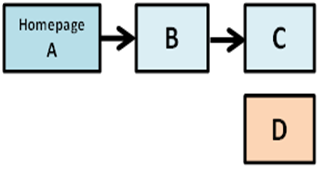
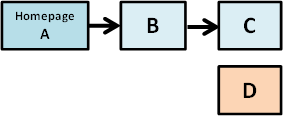
» Link Structure is very important  for search engines. Ensuring all the pages on a website are interlinked will ensure that the search engines crawl through all the pages and all the relevant content is indexed and listed. For Ex:

Here, Homepage A is linked to B which is linked to C but, page D is not linked to any of the pages. In this case, crawler would not crawl page D which in turn would not be indexed despite its great content and good keywords.

» Search engines store data on the basis of keywords in other words, there are millions of data indexed, when we enter words to perform a query, search engines go through their database and retrieve the information based on the words in the query. The way keywords are used on the page is measured by search engines to find the relevance of that information to a query. More specific the keyword leads to less competition and higher chances of achieving a higher ranking. To optimize a page’s ranking use the keywords you want to rank for prominently in title, text and metadata.
Over a period of time, this practice of keyword based indexing was taken advantage of to manipulate engines. This misguided effort is termed as ‘keyword stuffing’ wherein in keywords are stuffed into texts, meta tags, links and URLs which does more harm than good to the website.

» Description of a page’s content is shown at the top of Internet Browsing Software which is called ‘Title Tag’. It is critical to user experience as well as SEO. Keywords used in the title tags will be bold when a search query would be performed using those keywords. Title tags can be optimized in following ways:

a. Place keywords in the starting of title tags for better ranking and better visibility to the users.

b. The first 65-75 characters of the title tag are shown in the search result  by the search engines so,be wise while writing a title tag. If multiple keywords are targeted and it is important to include them in the title tag then go longer.

c. It should be descriptive and readable to grab more user attention and visitors to the site
» Metatags
:
a. Meta robots: They control crawler activity on per page level.
– Index/noindex tells search engine whether to index a page or not. Noindex excludes the page from indexing. By default crawler indexes all pages.
– Follow/nofollow tells whether to crawl link on the page. Nofollow stops crawler from crawling and ranking the link. By default crawler follow every link on the page.
– Noarchive tells the engine not to save cached copy of the page. By default crawler saves cached copy of the page.
b.   Meta Description: It gives a brief description about page and not used by crawlers for ranking. These descriptions are basically for advertising and drawing attention of readers.

» The addresses for documents on the web page are of great importance from search perspective and are called URLs. They are displayed in search result and also used in ranking documents. Construct a URL which gives an idea of the content on the page and is short, easy to copy & paste and visible in the search result. Include specific keyword in the URL which is targeted by web page. However, don’t stuff in multiple keywords for SEO, it will result in less usable URL.

» Many a times it happens that there are two or more duplicate versions of a web page with different URLs. Search engines rarely show multiple, duplicate versions of same content. Instead they choose a version which is most likely to be original. This may lead to lower ranking of pages than it should. To combine multiple pages into one Canonicalization is done. This practise tells the search engine that all duplicate versions has one and only one URL. This way duplicate pages stop competing against each other and create stronger relevancy signal overall.

From the above points we can see that keywords play a very important role in SEO so, choosing the right keyword for website is of utmost importance. Below are some of the sources about keyword referral and keyword demand:

a)   Google Trends

b)   Google Adwords Keyword Planner Tool

c)   Wordtracker’s Free Basic Keyword Demand

Search engines have no formula to understand how important the content is for people. They track what people do: what they discover, react, comment and link to on your website, and measure the importance and relevance on that basis. So, along with SEO, market your content to make sure it gets seen to the audience.